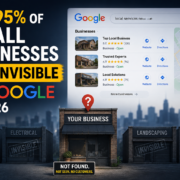
Why 95% of Small Businesses Are Invisible on Google in 2026

Google is the front door to modern business. If your company is not visible when prospects search, your competitors win by default.

1. Most Businesses Underinvest

Many firms spend thousands on vehicles and equipment but hesitate to invest consistently in online growth.

2. Poor Website Conversion

Traffic means little if visitors do not call, enquire or buy.

3. Weak SEO Foundations

Missing local pages, thin content, poor internal links and technical errors limit visibility.

4. Google Ads Without Strategy

Clicks without tracking and conversion analysis waste budget.

5. No Monthly Content Growth

Businesses that publish new pages and articles steadily compound their visibility.

6. Choosing the Wrong Agency

Many owners hire based on referrals rather than proven performance.

7. Competitors Keep Improving

Online marketing is not a one-off task. It requires continual iteration.

8. AI Widens the Gap

Businesses using AI to produce content, analyse data and improve conversion move faster.

Conclusion

The winners treat online marketing as a structured acquisition system rather than an occasional expense.


Strong Call to Action

If your website is underperforming, Online Media Direct can build a practical growth system combining SEO, Google Ads, WordPress improvements and conversion optimisation.


Why This Is My Top Recommendation

This article:

  • Matches your sales philosophy
  • Targets your ideal clients
  • Generates high-intent SEO traffic
  • Supports your “we build acquisition systems” positioning
  • Remains evergreen
  • Creates opportunities for local SEO spin-off content

Additional High-Performing Follow-Up Posts

  1. Why Most Businesses Waste Money on Google Ads
  2. Stop Renting Leads: Why SEO Builds a Long-Term Asset
  3. How AI Is Giving Small Businesses a Competitive Edge
  4. Website Conversion Mistakes That Cost You Enquiries
  5. What to Look for When Hiring an SEO Consultant

My Recommended Publishing Strategy

Publish this as a flagship article of 2,000–3,000 words with:

  • A strong featured image
  • Internal links to your SEO, Google Ads and WordPress pages
  • Real examples from your 25 years in internet marketing
  • A clear audit CTA

The next 90 days in Internet marketing (2 March to 31 May 2026)

What’s changing in SEO, WordPress, WooCommerce and Google Ads and what to do about it

The next 90 days will reward boring competence. Clean tracking. Fast pages. Safe updates. Content built for the surfaces that are actually sending traffic. If your marketing has felt “soft” lately, it’s usually not a creativity problem, it’s a measurement and platform-change problem. That’s the theme from March through May 2026.

Four moving parts are colliding at once:

  1. WordPress core is about to move with WordPress 7.0 scheduled for 9 April 2026 and it introduces changes that can affect how the editor renders and how plugins interact with admin screens.

  2. WooCommerce is about to move with WooCommerce 10.6 scheduled for 10 March 2026 and it includes performance and block refinements plus specific behaviour changes like default lazy-loading in Product Image blocks.

  3. Google’s discovery and SERP layouts are shifting. Google launched a February 2026 Discover core update on 5 February 2026 and confirmed rollout completion on 27 February 2026. In parallel, Google is preparing EU search-result experiments that may change how visibility is distributed in certain verticals, especially travel and hospitality style queries.

  4. Paid media measurement is still being rebuilt around consent and first-party data, while Google is also pulling creator marketing deeper into the Ads product with Creator Partnerships Hub and Partnership ads.

So what do you do with that?

This article is a practical plan you can run across your marketing stack in the next 90 days. If you only do one thing, do this: treat March as “measurement and performance month” then treat April as “platform updates month” then treat May as “distribution month” (SEO surfaces, creators and diversification). That sequencing reduces risk and it keeps you shipping.


March 2026: fix measurement first so every click counts

If your tracking is wrong, you can’t trust the campaign data and you can’t trust the automated bidding. The result is the worst kind of waste: you pay for traffic, then you pay again to “learn” from noisy data.

1) Consent Mode is now operational, not optional

For UK and EU businesses, you need a consent signal that is consistent and testable. Google’s own Consent Mode reference spells out consent types such as ad_storage, analytics_storage, ad_user_data and ad_personalization. Importantly, Google explicitly ties ad_user_data to measurement use cases like enhanced conversions and tag-based conversion tracking.

What to do this week (two-hour audit):

  • Open Tag Assistant and confirm consent states change correctly on accept and reject. Google’s verification guidance literally tells you what parameters to check.

  • Ensure the default consent state is set, then updated after a user choice (Google’s developer guide is clear on the “default then update” model).

  • Check for double-tagging: GA4, Ads and GTM misfires are common after “quick fixes”.

What success looks like by end of March:
Your conversion numbers won’t necessarily go up overnight, but they stop behaving like a random number generator. Your “top campaigns” don’t change every day and smart bidding stops oscillating.

2) Enhanced Conversions is the fastest win for lead gen and ecommerce measurement

Enhanced Conversions uses hashed first-party data from conversion pages to improve conversion measurement accuracy. Google describes it as capturing hashed, user-provided customer data and matching it in a privacy-safe way.

Where this matters most:

  • Lead gen forms (trades, B2B services, local service businesses)

  • Checkout completion (WooCommerce stores)

  • Any account where “conversion loss” has been creeping up

What to do this week:

  • Implement Enhanced Conversions on the conversion page templates (thank-you pages, lead form confirmations).

  • Confirm your data collection is minimal and relevant. You are not trying to hoover up everything, you are trying to restore measurement and maintain compliance.

  • Run a controlled before/after comparison over 14 days with identical budgets, then check conversion modelling stability.

If you run Google Ads in 2026 without Enhanced Conversions and a correct consent implementation, you’re flying with instruments that flicker.

3) Landing pages: speed and clarity beat gimmicks in March

Before you scale spend or content, get your money page experience tight:

  • One page, one job (call, quote request, add to cart)

  • Remove friction (forms that feel like a tax return)

  • Prioritise Core Web Vitals type basics: image sizing, caching, lazy-loading, preloading critical assets

This sets you up for April’s WordPress and WooCommerce changes without chaos.


Late March into April 2026: build the paid creative pipeline, then test creator-led ads

Google is not hiding the direction of travel: creator marketing is being productised inside Ads.

4) Creator Partnerships Hub and Partnership ads are becoming a serious lever

Google calls Creator Partnerships Hub “a new central place in Google Ads” for managing creator collaborations, including discovery, reporting across paid and organic and creator search and outreach.
Partnership ads powered by BrandConnect let advertisers promote YouTube creator videos in ad campaigns.

This matters for two reasons:

  • It reduces the friction of creator outreach and measurement

  • It makes creator content a scalable performance channel instead of a messy PR exercise

What to do in April (two-stage test):

  1. Stage 1 (7 days): Run a small creator-style creative test without creators. Film “creator format” assets yourself: face-to-camera, product or service demonstration, before/after, FAQs, short proofs.

  2. Stage 2 (14 days): If Stage 1 beats your baseline CPA or ROAS, run a Partnership ads test with a local creator or niche creator that matches your customer profile.

How to choose creators in a UK SME context:

  • Location relevance beats fame for local services

  • Demonstration beats vibe for ecommerce

  • Trust cues beat polish (show the work, show the process, show outcomes)

You’re not paying for celebrity. You’re buying credibility at scale.


April 2026: platform updates month (WordPress 7.0 and WooCommerce 10.6)

April is where good businesses quietly win because they update safely while competitors break things.

5) WordPress 7.0 is scheduled for 9 April 2026. Treat it as a project, not a button

WordPress.org’s own Beta 2 post states the scheduled final release date for WordPress 7.0 is 9 April 2026 and it highlights a new Connectors UI for managing external AI connections in wp-admin.

There is also a documented change around the editor: WordPress core has a post on “Iframed editor changes in WordPress 7.0” and notes that editors have been iframed already while the post editor is part of this shift.

What to do before you update:

  • Clone production to staging

  • Update plugins and themes in staging first

  • Click through every revenue path: contact forms, checkout, email confirmations, analytics events

  • Specifically test any custom admin UI your site relies on (page builders, custom metaboxes, bespoke blocks)

Why the Connectors UI matters even if you “don’t use AI”:
Anything that centralises external connections becomes a governance surface. You want to know what is connected, who can connect things and where the logs are. Even if you never touch it, your stack should be auditable.

6) WooCommerce 10.6 is scheduled for 10 March 2026. If you haven’t done it yet, don’t delay

WooCommerce’s developer update confirms 10 March 2026 as the final release date.

There are also specific performance-related behaviour changes like product images in the Product Image block being lazy-loaded by default starting with WooCommerce 10.6.

Lazy-loading is usually positive but it can change how images appear during loading states, it can affect LCP measurement and it can expose theme quirks. So test it.

WooCommerce 10.6 checklist for store owners:

  • Checkout blocks and payment gateways: test 5 full orders end-to-end in staging

  • Shipping rules: edge cases (postcode restrictions, free shipping thresholds)

  • Product pages: image galleries, zoom, variation switching

  • Tracking: GA4 purchase events, Ads conversion tags, server-side events if used

  • Performance: compare product page load and LCP before and after

If your WooCommerce store makes money every day, treat upgrades like you’d treat changing the till system in a busy shop. Rehearse it.


May 2026: SEO distribution shifts (Discover, EU SERP changes and what it means for you)

May is where you stop pretending “SEO” means ten blue links only. It doesn’t.

7) Google Discover is in play and it just had a confirmed update

Google’s Search Central blog announced the February 2026 Discover core update on 5 February 2026. Industry tracking and reporting also notes it completed rollout on 27 February 2026.

What this changes for content planning:

  • Discover rewards compelling topics and packaging, not just keyword targeting

  • Consistency matters. One good article is not a strategy

  • Relevance and local expertise are increasingly important in how content performs in these surfaces (and clickbait is a long-term loser)

Practical Discover-ready content moves for UK businesses:

  • Build a “90-day newsroom” for your niche: weekly commentary posts tied to customer questions, prices, regulations, seasonal demand

  • Use real photos where possible (job photos, product shots, behind the scenes). Keep them sharp and well framed

  • Put your best proof above the fold: outcomes, timelines, case studies, constraints, what you do and what you refuse to do

  • Refresh top performers: update the date, add new sections, add new FAQs, improve images, fix internal links

Discover is not something you “do once”. It is a publishing habit.

8) EU SERP layout changes are a reminder to diversify

Reuters reports Google plans to test search result changes in Europe under DMA pressure, including giving more visibility to rival vertical services especially for “hotels, flights and restaurants” style queries. The Verge summarises the same direction of travel: more prominence for rivals and phased rollout across Europe.

Even if you are not a travel business, the lesson is bigger: layout changes can move your clicks without your rankings changing. So May is diversification month.

Diversification moves that actually help:

  • Build an email list that is not rented attention

  • Strengthen brand search demand (content and social that makes people search your name)

  • Use YouTube and short video for “how it works” content (then repurpose into ads)

  • Build local citations and review velocity for local service queries

  • Create comparison pages and alternatives pages where appropriate (high-intent pages)

The goal is simple: no single Google surface should be able to wipe out your pipeline overnight.


Security and resilience: the quiet multiplier across the whole quarter

Updates bring benefits and risk, and attackers love slow-moving sites.

A recent example: Patchstack reported an SQL injection vulnerability in the “Quiz and Survey Master (QSM)” plugin affecting 40k+ sites and advised updating to a fixed version.

You don’t need to run that plugin to learn the lesson. The lesson is that WordPress sites are ecosystems of third-party code. If you want growth, you need a minimum viable security routine.

Minimum viable security routine (set it and keep it):

  • Weekly updates on staging, monthly on production (or faster if critical)

  • Remove unused plugins and themes

  • Enforce least-privilege user roles

  • Use reputable security monitoring and alerts

  • Keep backups and practise restore

Security is not a fear story, it is how you avoid losing a month of marketing progress to a preventable incident.


The 90-day scoreboard: what to track weekly

If you want to know whether the plan is working, track a short set of metrics weekly:

  • Leads or orders (the real number)

  • Cost per lead or cost per acquisition (by campaign type)

  • Conversion rate (sitewide and on the main money pages)

  • “Tracked conversions” vs “actual outcomes” gap (CRM or order records)

  • Top landing pages by revenue contribution

  • Search Console: clicks and impressions for your top topics

  • Site performance: LCP and page speed on your top pages

If any of these lines drift, you act fast. The point of weekly tracking is not reporting, it’s correction.


A clean 90-day action plan you can follow

If you want the simplest version, here it is:

Week 1–2 (March): Consent Mode audit, Enhanced Conversions, landing page friction fixes.
Week 3–4 (late March): Creative refresh, creator-format tests, rebuild your offer pages.
Week 5–6 (April): WordPress 7.0 staging rehearsal, WooCommerce 10.6 checks and performance review.
Week 7–9 (May): Discover-ready publishing cadence, refresh top pages, improve internal linking and media.
Week 10–12 (late May): Diversification sprint: email capture, YouTube pipeline, local SEO reinforcement, creator partnership pilot.


If you want Online Media Direct to run this for you

A sensible “done with you” stack for the quarter looks like:

  • Tracking and consent implementation audit, then Enhanced Conversions rollout

  • WordPress 7.0 and WooCommerce 10.6 staging rehearsal with a pass/fail report

  • A 12-week SEO and Discover content plan with internal links mapped to revenue pages

  • A Google Ads creative refresh and a creator partnership pilot with strict measurement

If you want, paste your main service pages and your primary conversion action (calls, quote forms or checkout) and I’ll tailor this plan to your exact site structure and niche.

Add a proper Q&A (FAQ) section for Google AI search

If your website is not getting as many enquiries as it should, there is a simple fix that punches above its weight.

Add a proper Q&A (FAQ) section.

Not a fluffy “Frequently Asked Questions” page with three vague questions, a real Q&A section built from the exact searches your customers type into Google, the exact objections they raise on calls and the exact “quick doubts” that stop them from clicking Contact.

Done properly, a Q&A section does three jobs at once:

  1. It captures long-tail searches (high-intent queries with lower competition)
  2. It increases conversions by removing friction and hesitation
  3. It gives Google cleaner context about what you do, where you do it and who you serve

And if we add Google Schema (structured data) to the Q&A, we can make it even easier for search engines to parse and trust the page.

Below is a ready-to-use, long-tail Q&A block you can adapt for your site. If you already have service pages, you can place the most relevant questions directly onto those pages too (that often works even better than hiding everything on one FAQ page).


WHY Q&A WORKS SO WELL (IN PLAIN ENGLISH)

Most website pages talk “at” visitors. A good Q&A talks “with” them.

People do not search like they speak to a salesperson. They search like this:

  • “How much does [SERVICE] cost in [TOWN]?”
  • “Is [SERVICE] safe for [MATERIAL/TYPE]?”
  • “Can you do [JOB] without [RISK/PROBLEM]?”
  • “How long does it take and what happens next?”
  • “Do you cover [AREA/POSTCODE]?”

When your site answers those questions clearly, you start ranking for the searches that bring enquiries, not just traffic.

It also improves lead quality. If you handle price range, timelines and what is included up front, you reduce tyre-kickers and increase serious enquiries.


COPY-PASTE Q&A SECTION (LONG-TAIL QUESTIONS + ANSWERS)

Use the bracketed parts to customise for your business: [SERVICE], [TOWN], [AREA], [INDUSTRY], [PRODUCT], [TIMEFRAME], [PRICE RANGE], [EMAIL], [PHONE]

Q1) How much does [SERVICE] cost in [TOWN] and what is included?
A) Pricing depends on scope, access, materials and the time required. As a guide, most projects fall into [PRICE RANGE], but we always confirm after a quick review so you know exactly what is included, what is optional and what is not. If you tell us your location and what you need, we can give a clear written quote.

Q2) Do you cover [AREA] and nearby towns as well?
A) Yes, we cover [AREA] plus surrounding towns and villages, including [TOWN/AREAS LIST]. If you are unsure, send your postcode and we will confirm availability and lead time.

Q3) How quickly can you start and what is your usual lead time?
A) Lead times vary by season and job size. Typical start times are within [TIMEFRAME]. If it is urgent, tell us the deadline and we will advise the fastest realistic option.

Q4) What happens after I contact you, step by step?
A) We confirm what you need, ask a few quick questions, then arrange a review (remote or on-site depending on the job). You receive a clear quote, timescale and next steps. Once approved, we schedule the work and keep you updated until completion.

Q5) Can you provide a fixed price quote rather than an estimate?
A) Yes. Once we understand the scope and any constraints, we provide a fixed quote in writing. If something changes, we discuss it before any additional cost is incurred.

Q6) What is the difference between [SERVICE] and [ALTERNATIVE SERVICE]?
A) The best option depends on the outcome you want, your budget and any risk factors. In general, [SERVICE] is better for [BENEFIT], while [ALTERNATIVE] may suit [OTHER BENEFIT]. We will recommend the safest and most cost-effective approach for your situation.

Q7) Is [SERVICE] safe for older properties or specific materials?
A) It can be, but method matters. We consider age, material type, condition and previous work before proceeding. If there is any risk, we adjust the process to protect the property and prioritise a controlled, low-risk approach.

Q8) Will [SERVICE] damage [SURFACE/MATERIAL] or affect warranties?
A) We work to manufacturer guidance where relevant and use methods suited to the surface. If you have documentation or warranty terms, share them with us so we can stay compliant and avoid voiding coverage.

Q9) How long does [SERVICE] take from start to finish?
A) Most jobs take between [X] hours and [Y] days depending on size and access. We will tell you the expected duration before starting and confirm when you can use the area normally again.

Q10) Do I need to be at the property during the work?
A) Not always. Many jobs can be completed with access arranged in advance. We confirm requirements up front and keep you updated with photos or a completion note where helpful.

Q11) What should I do to prepare before you arrive?
A) We will provide a short checklist, but common prep includes clearing access, moving fragile items and ensuring parking or entry is available. If anything specific is needed, we will tell you in advance.

Q12) Do you offer evening or weekend appointments?
A) Where scheduling allows, yes. If you need an out-of-hours slot, tell us your preferred times and we will try to accommodate.

Q13) Are you insured and can you provide proof?
A) Yes, we carry appropriate insurance for the work we do. If you need proof for compliance or peace of mind, we can provide it on request.

Q14) Do you offer any guarantee or warranty on [SERVICE]?
A) Where guarantees are appropriate, we are clear about what is covered and for how long. Some outcomes depend on factors outside anyone’s control (weather, usage, maintenance), so we set expectations honestly and recommend next steps to protect the result.

Q15) Can you show examples of past work in [TOWN] or [AREA]?
A) Yes. We can share recent examples, photos and relevant case studies. If you want something comparable to your job, tell us what you are looking for and we will send the closest match.

Q16) What makes you different from cheaper providers?
A) Cheap quotes often hide missing steps, rushed work or higher risk methods. We focus on doing it correctly, using suitable methods and clear communication so you get a reliable result and fewer issues later.

Q17) What are the most common hidden problems you find?
A) We often uncover issues like [COMMON ISSUES: damp ingress, cracked pointing, blocked drainage, underlying wear, misdiagnosed faults]. We flag anything important, explain your options and let you decide how to proceed.

Q18) Can you work around customers, tenants or business opening hours?
A) Yes. We regularly plan work to reduce disruption, including staged work, quieter time windows and clear safety boundaries.

Q19) Do you provide emergency call-outs for [SERVICE]?
A) In some cases, yes. If it is urgent, contact us with the issue, location and photos if possible. We will confirm the fastest response available and what can realistically be done immediately.

Q20) Do you offer maintenance plans to prevent repeat problems?
A) Yes. Maintenance is often the cheapest long-term strategy. We can recommend a simple schedule based on your property type, environment and risk factors.

Q21) What areas do you specialise in within [INDUSTRY]?
A) We focus on [SPECIALISMS], but we also handle related work where it makes sense. If you are unsure whether we cover your job, ask and we will confirm.

Q22) Can you provide invoices/receipts for accounts or insurance?
A) Yes. We provide proper paperwork and clear descriptions of what was done, which helps for accounting, landlord records or insurance claims.

Q23) Do you offer discounts for multiple jobs or repeat visits?
A) Often, yes. If you bundle work (or schedule repeat visits), we can usually reduce overall cost because setup and travel are more efficient.

Q24) What is the best way to get a fast quote?
A) Send a short description, your postcode and a few photos (if relevant). Include your preferred timescale. We will respond with the next step and a clear quote process.

Q25) Who is [SERVICE] not suitable for?
A) If someone needs [EDGE CASE], has severe constraints or expects [UNREALISTIC EXPECTATION], we will say so up front. We would rather be honest than take on work that cannot be delivered properly.

Q26) What should I look for when choosing a provider for [SERVICE]?
A) Look for clarity on what is included, proof of insurance where needed, realistic timelines and a method that matches your surface or property type. Also watch for vague quotes that avoid specifics.

Q27) Can you explain your process in plain English before I commit?
A) Yes. We will explain the method, expected outcome and any risks in simple terms. If it cannot be explained clearly, it is usually a sign something is being glossed over.

Q28) How do I book and what payment methods do you accept?
A) Booking is simple: confirm the quote, choose a date and we reserve the slot. We accept [PAYMENT METHODS]. Payment terms are agreed up front with no surprises.


GOOGLE SCHEMA (STRUCTURED DATA) AND WHY IT MATTERS

When we add FAQ Schema (typically JSON-LD) to your Q&A section, we are effectively labelling each question and answer so search engines can interpret it reliably.

Important: schema must match what is visible on the page. We do not mark up “hidden” content or answers users cannot see. Done correctly, it improves clarity, reduces ambiguity and supports richer interpretation of your services.


WANT US TO BUILD THIS FOR YOU?

If you want this done quickly and properly, we can:

  • Pull real long-tail questions from your industry, location and Search Console data
  • Write a high-converting Q&A section tailored to your services
  • Implement FAQ Schema (JSON-LD) cleanly in your site
  • Place the best questions onto the right service pages (not just a single FAQ page)
  • Track performance and expand the Q&A monthly to keep growing coverage

Why FAQ Schema matters

A normal Q and A section is readable for humans.

Schema code makes it readable for machines.

FAQ Schema (usually JSON-LD code) labels each item as a Question and an Answer. That reduces ambiguity and helps Google interpret your content accurately.

It is not a magic ranking switch, but it improves understanding, and that supports visibility across multiple search surfaces, including People Also Ask, snippets, and AI generated summaries where Google is looking for clean, structured answers.

Critical rule: the schema must match what is visible on the page. Do not mark up hidden answers or content that users cannot see.

How this helps AI search and modern Google results

Search is no longer just ten links.

Users see People Also Ask boxes, featured snippets, local results, and increasingly AI generated answers.

Those systems need short clear answers.

Q and A section is already in the format these systems prefer, and schema makes it easier for Google to extract the right answer and attribute it correctly.

If AI is going to answer the question anyway, you want your site to be the cleanest source for the answer, and you want the visitor who is ready to act to land on your page, not a directory or a competitor.

How to write answers so they work for rankings and enquiries

Use this format.

  1. Answer in the first sentence
  2. Add a practical range if possible, time cost or duration
  3. Add one constraint or exception, to build trust
  4. Add the next step, what the reader should do now

Regards,
Garry

Google Updates the previous 2 years.

Google has shipped repeated core + spam rollouts. If your leads depend on rankings, treat this as your warning.

This is the uncomfortable email most business owners ignore until AFTER the damage is done.

Google has been running back-to-back algorithm rollouts for two years. Not “a small tweak”. Not “a minor change”.

A full re-score of who deserves visibility, who gets pushed down, and who gets quietly filtered out.

If your business relies on Google for enquiries, leads, bookings or sales, you need situational awareness. Because the next update will not ask permission. It will simply move your traffic.

Below is a clean changelog of what’s happened over the last ~2 years, plus what Google is most likely to target next.


CHANGELOG: WHAT GOOGLE HAS BEEN DOING (LAST ~2 YEARS)

MARCH 2024 — CORE UPDATE (major re-scoring) • Broad ranking reshuffle focused on “useful vs made-to-rank” content. • Translation: sites with thin, repetitive, click-chasing pages started losing ground.

MARCH 2024 — SPAM UPDATE + NEW SPAM POLICIES • Google tightened enforcement and explicitly called out three abuse patterns:

  1. Expired domains repurposed to rank
  2. Scaled content produced at volume “for rankings”
  3. Site reputation abuse (“parasite SEO” / reputation renting) • Translation: if your strategy relies on shortcuts, it became a liability.

JUNE 2024 — SPAM UPDATE (policy enforcement pass) • Broad spam enforcement across languages. • Translation: anything borderline (doorways, scraped pages, manipulative tactics) became riskier.

AUGUST 2024 — CORE UPDATE (quality emphasis) • Designed to show more content people find genuinely useful, less content made mainly to perform in search. • Translation: “looks SEO’d” stopped being enough. Usefulness and satisfaction mattered more.

NOVEMBER 2024 — CORE UPDATE (another broad recalibration) • More turbulence, more re-weighting. • Translation: if you didn’t genuinely improve site quality, you were exposed again.

DECEMBER 2024 — CORE UPDATE (fast reshuffle) • A quick rollout that still moved rankings materially for many sites. • Translation: volatility became the new normal.

DECEMBER 2024 — SPAM UPDATE (immediately after) • Spam enforcement followed right after the core update. • Translation: December losses were often a double hit — re-score + enforcement.

MARCH 2025 — CORE UPDATE (re-scoring continues) • Another broad update designed to surface relevant, satisfying content across many site types. • Translation: “average” pages got squeezed. Winners were clearer, deeper, more trustworthy.

JUNE 2025 — CORE UPDATE (yet another re-weighting) • Continued broad recalibration of ranking systems. • Translation: reliance on one tactic (one content type, one keyword pattern, one link method) became fragile.

AUGUST 2025 — SPAM UPDATE (global) • Broad spam update across languages worldwide. • Translation: Google kept tightening the net around policy violations.

DECEMBER 2025 — CORE UPDATE (up to ~3 weeks rollout) • Another broad, long rollout that re-scored sites across verticals. • Translation: if your traffic “fell off a cliff” in December, this is a prime suspect.


THE BIT MOST PEOPLE GET WRONG (BACKLINKS)

Here’s the truth:

Google doesn’t publish “we checked backlinks” patch notes for core updates.

But links are always in the mix. If your site is propped up by low-quality links, paid networks, or mystery backlink packages you can’t explain, you are not “safe” — you are simply not hit yet.

Core updates are the re-score. Spam policies are the enforcement hammer. If you’re on the wrong side of either, the outcome is the same: visibility drops, leads drop, revenue drops.


NEXT LIKELY TARGETS (WHAT GOOGLE WILL FOCUS ON NEXT)

If you want a risk watchlist for 2026, it looks like this:

  1. SCALED AI CONTENT THAT ADDS LITTLE VALUE • Not “AI” as a tool — AI used like a printing press. • Thin pages, near-duplicates, templated city/service pages, filler blogs.
  2. “PARASITE SEO” / REPUTATION RENTING • Third-party commercial content living on sites purely to borrow authority. • Irrelevant affiliate sections, sponsored “shopping” areas, white-label inserts.
  3. EXPIRED DOMAINS + REDIRECT GAMES • Rebuilds and redirects designed to inherit old authority and rank quickly.
  4. LINK MANIPULATION (THE QUIET LANDMINE) • Paid links, PBNs, low-quality blasts, “guaranteed DA links”. • Anything you wouldn’t want reviewed by a human.
  5. UX + TRUST SIGNALS (THE SLOW BLEED) • Slow mobile experience, poor layout, confusing navigation, weak transparency. • No proof, no substance, no real-world credibility.

RED ALERT: IF ANY OF THESE ARE TRUE, YOU’RE EXPOSED

[ ] We publish content mainly to target keywords, not to help buyers [ ] We have lots of thin pages that don’t earn their place [ ] We used cheap link building, and can’t clearly account for the sources [ ] We have “location pages” that are basically the same page 50 times [ ] We host third-party sections that don’t belong to our core business [ ] Search Console hasn’t been checked in months [ ] Mobile site speed / user experience is “good enough” (it isn’t)


WHAT TO DO (BEFORE THE NEXT DROP)

Reply with: AUDIT

I’ll send an “Emergency SEO Risk Checklist” that identifies: • which pages are dragging your site down • where duplication/thin content is hurting you • link-risk warning signs • indexing/crawl problems that silently bleed visibility • quick wins vs structural fixes

Because the worst moment to act is AFTER the update finishes rolling out and your leads are already gone.