
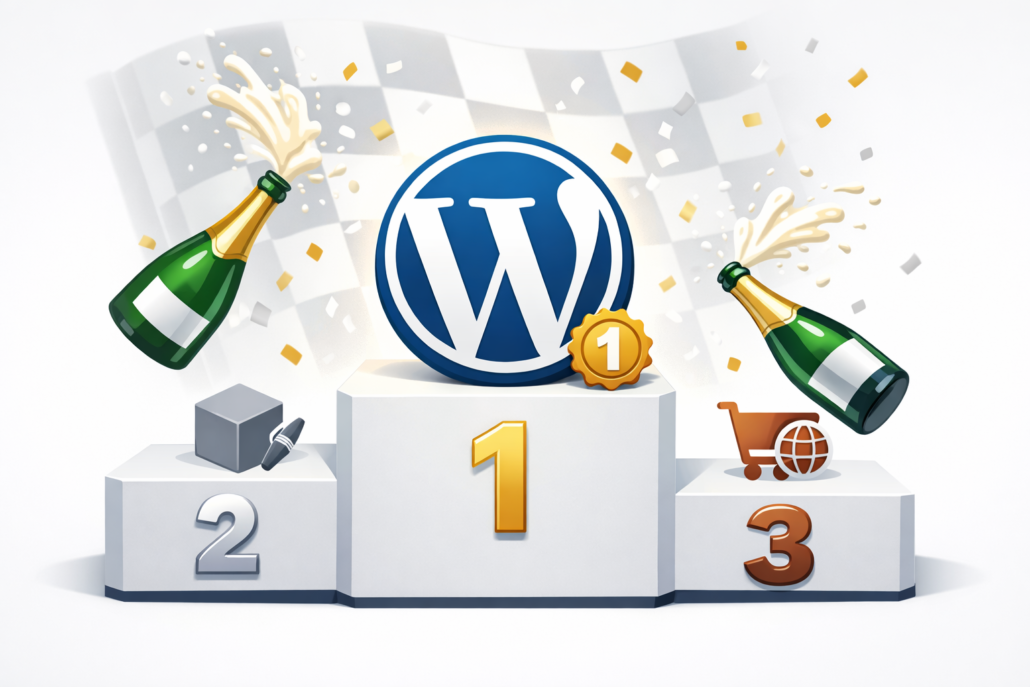
WordPress Wins the UK CMS market share race in 2026
- UK numbers, plus the commercial reasons WordPress keeps winning.
- Open source ownership, bigger ecosystem, WooCommerce-ready.
- If you ever want to scale, start on the standard.
If your website is still “built by an IT guy”, “just a few HTML pages”, or locked into a closed builder you don’t fully control, 2026 is the year to fix it.
Here’s the simplest reason: WordPress is the default standard for a reason. It’s the most-used CMS on the web, and in the UK it dominates the mainstream options. When you choose the platform the market standardises on, you buy yourself four things: choice, leverage, speed, and lower long-term cost.
UK platform reality (not opinions)
On .uk websites where a CMS is detected, the leading platforms break down roughly like this:
WordPress: 58.5%
Shopify: 9.9%
Wix: 8.9%
Everyone else combined: ~22.7% (Squarespace, Joomla, Drupal, Webflow, and hundreds more)
So if you want the “safest” option for hiring, support, integrations, and future-proofing, the market is telling you what it picked.
Why WordPress beats closed builders for most UK firms
1) It’s open source = real ownership
With WordPress you’re not renting a walled garden. You can move hosts, move agencies, change designs, add features, and keep your data without being boxed in by a vendor roadmap.
Control and portability is the core advantage.
2) Bigger ecosystem = faster results
Because WordPress is the world’s most-used CMS, it has:
- more developers to hire
- more agencies that can support it
- more plugins and integrations (marketing, SEO, bookings, CRM, analytics, compliance)
- deeper documentation and community knowledge
When something breaks or you need a feature, you’re not waiting for a platform to “maybe ship it”.
3) WooCommerce makes it an all-round system in 2026
If you ever want to sell online (even a small catalogue, payments, bookings, subscriptions, click & collect), WooCommerce turns WordPress into a full eCommerce platform without forcing you into an expensive enterprise stack.
And if you don’t need eCommerce today, you still have the option tomorrow without rebuilding from scratch.
4) Easier day-to-day management
For non-technical staff, WordPress typically wins on:
- editing pages/posts quickly
- media uploads
- permissions and user roles
- structured content
- simpler handover/training
A novice can become competent fast, especially with a clean setup.
The practical question
Do you want your website to be: A) A locked product you rent
or
B) A business asset you control
If you want B, WordPress is usually the most commercially sensible route.
If you reply with the word AUDIT, I’ll send back a quick checklist of what you’d need for a clean WordPress build (and the common traps to avoid), plus a simple migration plan if you’re currently on another platform.


Leave a Reply
Want to join the discussion?Feel free to contribute!